
Year-End Life Insurance Review for Business Owners
Every December your CPA closes the books, your company’s numbers get updated, and the calendar runs out on this year’s gift exclusions. It’s also the best time of year to pull out the life insurance that’s supposed to protect your business and your estate, and make sure it still does the job you bought it for.
Most owners we meet have a buy-sell agreement, a key person policy, or an estate policy sitting in a file. What they rarely have is a recent look at whether those policies still match the business. Many of the term policies we review were bought 15 to 20 years ago, and they don’t come close to covering what the business is worth today. As we put it to business groups here in Chattanooga: the agreement says a buyout happens; it never says where the money comes from.
At The Infinite Wealth Group, our Chattanooga independent life insurance agency runs year-end reviews for owners whose family estates are above $20 million. This checklist covers the three reviews we run before December 31: the annual in-force policy review, the buy-sell valuation check, and the IRC § 101(j) notice-and-consent check on company-owned policies.
Educational note: The Infinite Wealth Group is an independent life insurance agency. This article provides general insurance education, not tax or legal advice. Review tax filings, trust terms, and buy-sell documents with your attorney and CPA.
Why Should Business Owners Review Life Insurance Before December 31?
Year-end lines up four things at once: annual gift exclusions that expire on December 31, company financials and valuations being updated, your CPA preparing the returns that carry life insurance reporting, and another year of age and health that affects what new coverage costs.
- Gift exclusions are use-it-or-lose-it. The 2026 annual gift tax exclusion is $19,000 per recipient ($38,000 when spouses split gifts). If your irrevocable life insurance trust (ILIT) relies on annual exclusion gifts to pay premiums, those gifts and their Crummey notices need to happen in the calendar year. For 2027, Rev. Proc. 2026-35 raises the exclusion to $20,000 per recipient ($40,000 split).
- The business has a new number. Year-end financials are when owners learn what the company earned and, often, what it’s worth. That’s the number your buy-sell coverage should match.
- Your CPA needs the paperwork. Company-owned policies on employees and owners carry an annual IRS reporting form. The CPA can only file it if the underlying consent exists.
- Insurability doesn’t wait. Adding coverage before a health change is far easier than after one.
What Does an Annual In-Force Policy Review Cover?
An in-force review checks five things on every policy: how the policy is performing against its original illustration, who owns it and who gets paid, whether premiums are on track, which riders and deadlines are coming up, and how much is borrowed against it.
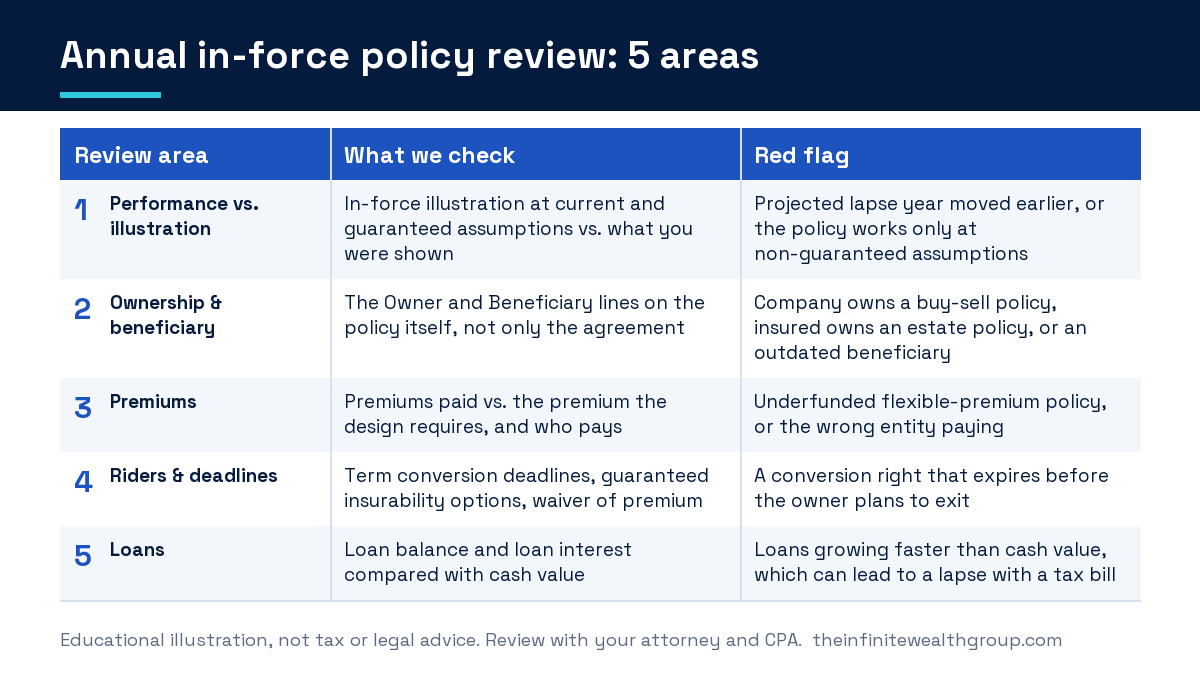
| Review Area | What We Check | Red Flag |
|---|---|---|
| 1. Performance vs. Illustration | A current in-force illustration at current and guaranteed assumptions, compared with what you were shown at purchase | The projected lapse year has moved earlier, or the policy only works at non-guaranteed assumptions |
| 2. Ownership & Beneficiary | The Owner and Beneficiary lines on the policy itself, not only what the buy-sell or trust says | The company owns a buy-sell policy, the insured owns an estate policy, or a beneficiary is outdated |
| 3. Premiums | Premiums paid vs. the premium the design requires, and who is paying | Underfunded flexible-premium policies, or the wrong entity paying |
| 4. Riders & Deadlines | Term conversion deadlines, guaranteed insurability options, waiver of premium | A conversion right that expires before the owner plans to exit |
| 5. Loans | Outstanding loan balance and loan interest compared with cash value | Loans growing faster than cash value, which can lead to a lapse with a tax bill |
A few notes from our reviews:
- Ask for the in-force illustration, not the annual statement. The statement shows what happened last year. The in-force illustration projects forward. We re-run it at the guaranteed column and show you the year it lapses, or tell you it doesn’t.
- Read the Owner line. If an estate policy is owned by the insured, the death benefit is included in the estate under IRC § 2042. Moving it to a trust starts the 3-year clock under IRC § 2035, so the sooner that conversation happens with your estate attorney, the better.
- Watch the loans. Policy loans on a non-MEC policy are generally not taxable while the policy stays in force, but a lapse or surrender with a loan outstanding can create taxable income under IRC § 72(e).
- Know what is guaranteed. On participating whole life, the premium, death benefit, and a schedule of cash values are guaranteed, backed by the issuing insurer’s claims-paying ability and assuming required premiums are paid. Dividends are not guaranteed, so a review should show both columns.
Does Your Buy-Sell Coverage Still Match What Your Business Is Worth?
If the business has grown and the coverage hasn’t, the surviving owners face a funding gap at the worst possible time. Year-end is when you compare each owner’s share of the current value with the death benefit behind it, and confirm who owns the policies after the Supreme Court’s Connelly decision.
Start with the question we ask every room of business owners: if your partner dies, do you want to be in business with their spouse? If the answer is no, the buy-sell has to be funded at today’s value, not the value from the year it was signed.
Our team recently met with two brothers who own an electrical contracting company. Their buyout plan was backed by term policies bought 18 years earlier. Those policies were about to expire, and the death benefit was far below what the company is worth today. That’s the most common pattern we see: a well-intended agreement that the business outgrew.
Three checks belong in every year-end buy-sell review:
- Update the price. Many agreements use a fixed price or an old formula. Under IRC § 2703, the IRS can disregard a buy-sell price for estate tax purposes unless the agreement is a bona fide business arrangement, is not a device to pass the business to family for less than full value, and has terms comparable to arm’s-length deals. Ask your attorney whether your valuation clause still holds up.
- Match coverage to each owner’s current share. Compare each owner’s share of today’s value with the death benefit on that owner’s life. If there’s a gap, decide whether to add coverage, exercise a guaranteed insurability option, or convert term coverage while you still can.
- Check who owns the policies. In Connelly v. United States (2024), the Supreme Court held that life insurance proceeds received by a company to redeem a deceased owner’s shares increased the company’s value for federal estate tax, with no offset for the redemption obligation. For owners whose estates are above the $15,000,000 per-person exclusion in 2026 ($15,480,000 in 2027), that added value can be taxed at 40%. We walk through the ownership options in our guide to buy-sell agreement life insurance after Connelly, and the trigger and valuation mechanics in using life insurance to fund business succession.
Don’t change policy ownership on your own to fix a Connelly problem. Moving a policy between co-owners can trigger the transfer-for-value rule under IRC § 101(a)(2). Bring the policies and the agreement to your attorney, your CPA, and us together.
Are Your Company-Owned Policies Compliant With IRC 101(j)?
When a business owns a life insurance policy on an employee or owner and is its beneficiary, IRC § 101(j) limits the tax-free death benefit to the premiums and other amounts paid, unless the written notice and consent requirements were met before the policy was issued and an exception applies.
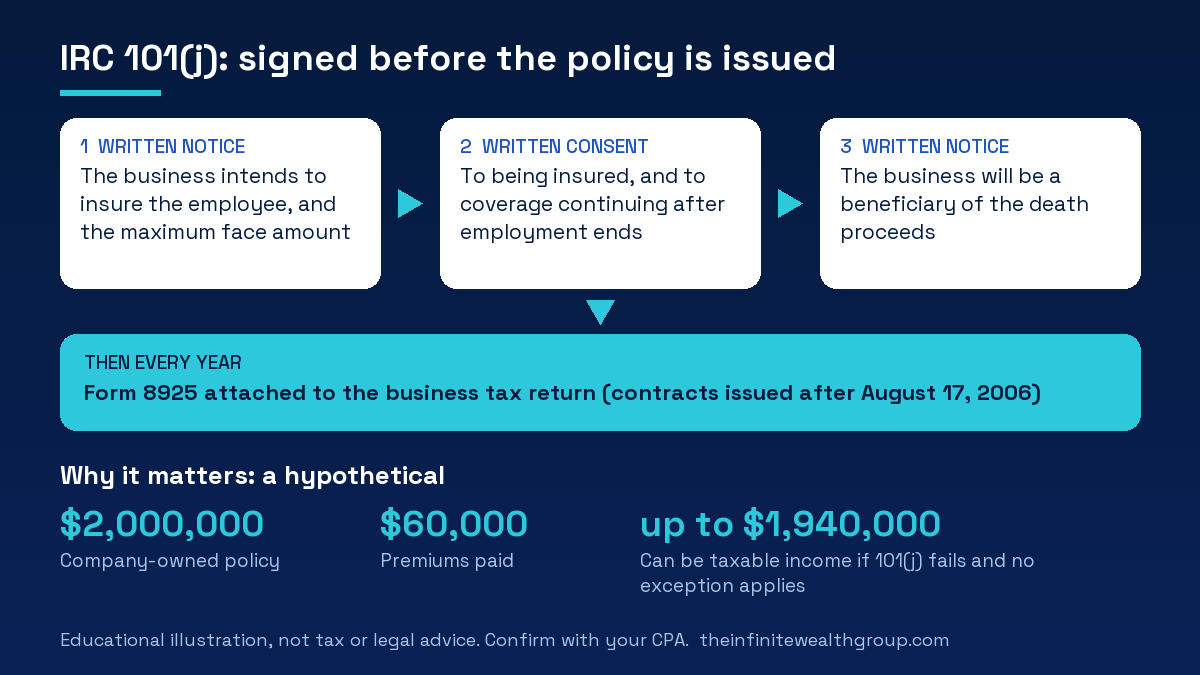
This covers most key person policies and entity-redemption buy-sell policies. Under § 101(j)(4), before the policy is issued, the insured employee must:
- Be notified in writing that the business intends to insure the employee’s life, and the maximum face amount for which the employee could be insured at the time the policy is issued.
- Give written consent to being insured and to the coverage continuing after the employee leaves.
- Be informed in writing that the business will be a beneficiary of the death proceeds.
For this purpose, “employee” includes officers, directors, and highly compensated employees, so owners who work in the business are covered too. When notice and consent were met, the full death benefit can stay income-tax-free if an exception in § 101(j)(2) applies. The exceptions include an insured who was an employee at any time in the 12 months before death, an insured who was a director or highly compensated employee when the policy was issued, and proceeds paid to the insured’s family, beneficiaries, a trust for them, or the estate, or used to buy an ownership interest from them (the common buy-sell case).
Here is why this matters. Take a hypothetical $2,000,000 company-owned key person policy with $60,000 of premiums paid. If the notice and consent requirements were not met, no exception applies, and up to $1,940,000 of the death benefit can become taxable income to the business.
The statute requires the notice and consent before issuance, so a form signed after the policy is issued does not meet the test as written. If you find a missing consent during a review, talk to your CPA and tax attorney about your options, which can include new coverage issued with proper consent.
Form 8925: The Annual Piece
Under IRC § 6039I, a business that owns employer-owned life insurance must report each year the number of employees, the number insured, the total insurance in force, and whether it has a valid consent for each insured employee, and it must keep the records to prove it. The IRS uses Form 8925 for this. The form says to attach it to the policyholder’s tax return, and it applies for each tax year the business owns an employer-owned contract issued after August 17, 2006.
If your company already has a policy on a partner or a manager, there’s a form that’s supposed to exist. In our experience, it often doesn’t. Your CPA files Form 8925. I make sure the consent exists before the policy issues, so there’s something to file. For how key person coverage is sized and owned, see our guide to key person life insurance.
What Year-End Gifts and Deadlines Affect Your ILIT and Estate Coverage?
If an irrevocable life insurance trust owns your estate policy, December is when this year’s premium gifts, Crummey notices, and trust records need to be complete. It’s also the time to plan next year’s gifts at the new 2027 amounts.
- Make this year’s annual exclusion gifts by December 31. In 2026 that’s $19,000 per beneficiary, or $38,000 when you and your spouse elect to split gifts. Next year it rises to $20,000, or $40,000 split.
- Send and file the Crummey notices. Each gift that relies on the annual exclusion should be paired with a written notice of the beneficiary’s withdrawal right. Our guide to Crummey notice requirements for an ILIT covers what the letter says and how to document it.
- Check the premium due date against the gift date. The trustee should receive the gift, wait out the withdrawal window your attorney set, and then pay the premium from the trust.
- Revisit the coverage amount. The federal basic exclusion amount is $15,000,000 per person in 2026 and $15,480,000 in 2027, with a 40% top rate above it. Tennessee has no inheritance tax, so for Tennessee families the federal bill is the one that drives coverage. Our page on estate planning with life insurance and ILITs explains how trusts and survivorship coverage fit together.
Year-End Life Insurance Review Checklist for Business Owners
Bring these items to one meeting with your attorney, your CPA, and our team:
- Current in-force illustrations for every policy, at current and guaranteed assumptions.
- The Owner and Beneficiary lines for every policy, compared with your buy-sell agreement and trust documents.
- A current business valuation and each owner’s share, next to the death benefit on that owner’s life.
- Term conversion deadlines and any guaranteed insurability option dates.
- Policy loan balances and loan interest compared with cash values.
- Signed 101(j) notice and consent forms for every company-owned policy, dated before the policy was issued, and confirmation that Form 8925 is attached to the business tax return each year.
- ILIT gift records and Crummey notices for this year, and a gift plan for 2027 at $20,000 per beneficiary.
Frequently Asked Questions
How often should a business owner review life insurance?
We recommend a review every year, and year-end is the natural time because business values, tax filings, and annual gift exclusions all reset on the calendar. A review should also happen after any ownership change, a large jump in business value, a new partner, a sale offer, or a change in health or family.
What is an in-force illustration and why does it matter?
An in-force illustration is a projection of an existing policy from today forward, using the policy’s actual values. It shows whether the policy is on track compared with the original sales illustration, and at guaranteed assumptions it shows whether and when the policy could lapse. Request one from the insurer every year for each policy.
What happens if our company never got 101(j) consent?
If a business owns a policy on an employee or owner and the notice and consent requirements of IRC § 101(j)(4) were not met before the policy was issued, the tax-free portion of the death benefit can be limited to the premiums and other amounts paid. Because the statute requires notice and consent before issuance, talk to your CPA and tax attorney promptly about your options.
Do we need to file Form 8925 every year?
Generally, yes. The IRS Form 8925 instructions say every policyholder owning one or more employer-owned life insurance contracts issued after August 17, 2006 must file it for each tax year the contracts are owned, attached to the policyholder’s tax return. Your CPA prepares it; the consent records come from the business.
Should we update our buy-sell coverage every year?
Compare coverage with current value every year, and update it when the gap matters. Under IRC § 2703, the agreement’s price may be disregarded for estate tax unless it meets the statutory tests, and after Connelly, who owns the policy can change the estate tax result. Confirm structure changes with your attorney and CPA before acting.
How do we schedule a year-end review with The Infinite Wealth Group?
Call our Chattanooga office at (855) 526-2979 before December 31. We’ll pull every policy apart line by line, re-run the in-force illustrations at the guaranteed column, check ownership, beneficiaries, and 101(j) paperwork, and compare your coverage with today’s business value, working alongside your attorney and CPA. You can also start with our pages on life insurance strategies for business owners and business exit strategy and buy-sell funding.
Related Articles
Have Questions?
Book a free fifteen-minute discovery call with Brandt. No pitch, just your numbers and a straight answer.
Explore Our Strategies

Brandt Hudson
Founder of The Infinite Wealth Group, a Chattanooga, TN life insurance agency. Licensed insurance professional; designs infinite banking, LIRP, defined benefit, estate and business exit strategies across roughly fifty carriers.