
Buy-Sell Agreement Life Insurance in Tennessee (2026)
A buy-sell agreement without dedicated funding is only a promise to buy a partner’s shares during a crisis. For closely held business owners in Chattanooga and across Tennessee, pairing a properly drafted buy-sell agreement with properly owned life insurance turns that contract into cash, generally income-tax-free, when an owner dies.
Most multi-owner companies already have an operating agreement or shareholder agreement sitting in a binder. The problem shows up when a co-owner dies unexpectedly and the surviving partners must come up with millions of dollars in cash while stabilizing customers, employees, and bank relationships, and while the deceased partner’s family faces a federal estate tax bill on a short federal deadline.
At The Infinite Wealth Group, our Chattanooga estate and business life insurance agency works alongside your corporate attorney and CPA to design, underwrite, and structure the life insurance policies that back your buyout agreement. This guide is written for co-owners whose family estates are above $20 million, where business value, estate tax, and liquidity all collide. It explains how buy-sell life insurance works in Tennessee, why policy ownership matters more than ever after the Supreme Court’s Connelly ruling, and how to avoid the valuation and tax traps that catch growing partnerships.
Educational note: The Infinite Wealth Group is an independent life insurance agency. This article provides general insurance education, not tax or legal advice. Always coordinate your buy-sell contract and tax structure with your corporate attorney and CPA.
What Does Buy-Sell Agreement Life Insurance Do for Tennessee Businesses?
Buy-sell agreement life insurance provides cash, generally income-tax-free under IRC § 101(a), so surviving business owners can purchase a deceased partner’s ownership interest at an agreed price. Instead of draining company working capital or taking on new bank debt after a death, the policy delivers cash when the buyout obligation triggers.
When a co-owner of a closely held Tennessee business passes away, two sets of priorities collide immediately:
- The surviving owners want control and continuity. They do not want an inactive spouse, adult children, or an estate executor voting on company operations, drawing distributions, or questioning management compensation.
- The deceased owner’s family wants fair value in cash. For many business-owning families, the company is the largest single asset they own. The family needs liquid cash to replace income and, for estates above the 2026 federal exemption of $15,000,000 per person ($30,000,000 for a married couple with portability), to pay federal estate tax at a top rate of 40% on the amount above the exemption.
Tennessee has no inheritance tax for deaths after December 31, 2015, and no state estate tax, but Tennessee business owners with significant enterprise value remain fully exposed to the federal estate tax. If your family estate is above $20 million and much of it is tied up in the company, keep in mind that the IRS does not accept illiquid LLC units or S corporation shares as payment. A funded business exit strategy and buy-sell funding plan solves both problems with the same check: the surviving partners get the equity, and the deceased partner’s estate receives cash.
How Should Tennessee Co-Owners Structure Policy Ownership?
A buy-sell life insurance policy can be owned by the operating company (entity redemption), by the individual partners on each other (cross-purchase), or by a separate insurance-only LLC. Since the U.S. Supreme Court’s unanimous 2024 decision in Connelly v. United States, company-owned redemption policies can increase your company’s value for federal estate tax purposes.
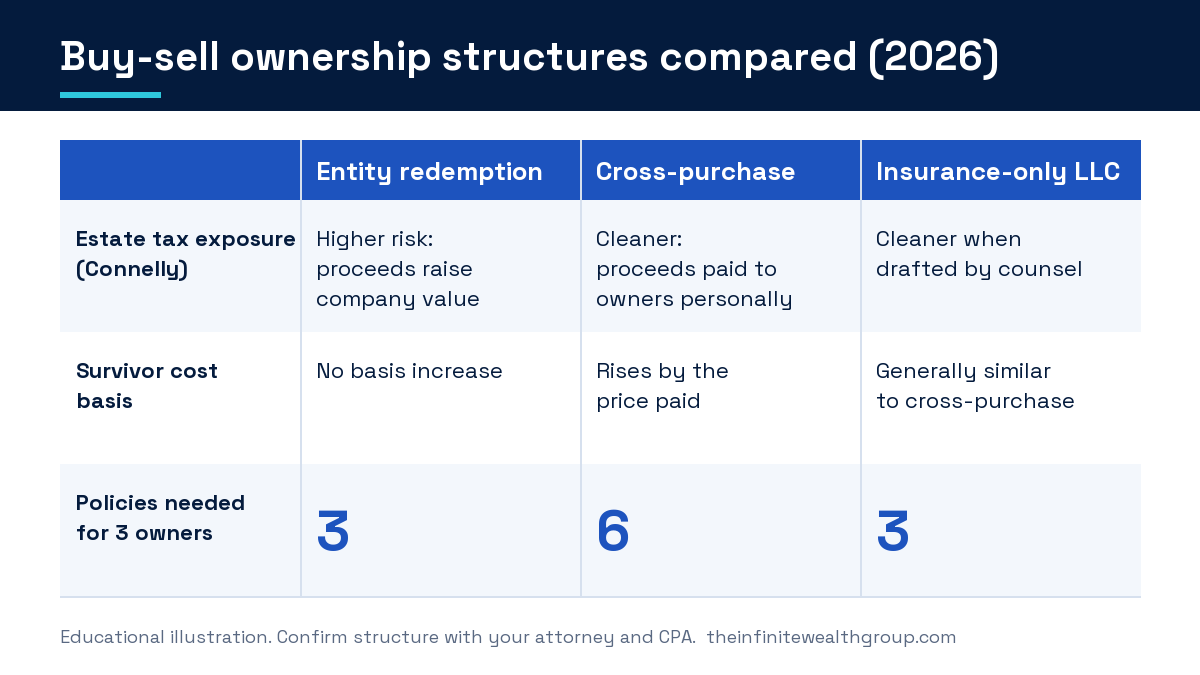
Before ordering coverage, you and your legal counsel must decide who owns the policies, who pays the premiums, and who receives the death benefit. Think of the IRS estate tax review like a highway weigh station: when a partner dies, the IRS weighs everything on the company truck. Where the life insurance check lands determines whether the IRS adds that check to the taxable value of the deceased partner’s shares.
| Structure | Who Owns Policy & Pays Premium | Estate Tax Impact (Connelly) | Surviving Owner Cost Basis | Policies Needed for 3 Owners |
|---|---|---|---|---|
| Entity Redemption (Stock Redemption) | Operating company owns a policy on each owner and is the beneficiary | Higher risk: the death benefit lands inside the company and can increase its value for estate tax | No basis increase: the company retires the shares, so the survivors’ basis does not rise | 3 policies (1 per owner) |
| Cross-Purchase Agreement | Each partner personally owns a policy on every other partner | Cleaner: proceeds go to the surviving partners personally, not onto the company’s books | Basis increase: survivors buy shares directly, so their cost basis rises by the price paid (IRC § 1012) | 6 policies (N x (N – 1)) |
| Insurance-Only LLC (Special Purpose LLC) | A separate LLC owned by the partners holds all policies under a master agreement | Cleaner when properly drafted by counsel: proceeds stay out of the operating company | Generally similar to a cross-purchase when structured with tax counsel | 3 policies (1 per owner) |
1. The Entity Redemption Trap After Connelly
For decades, entity redemption was a common default because it felt simple: the business bought one policy on each owner, paid the premiums from the corporate account, and agreed to redeem the shares at death.
In Connelly v. United States (2024), two brothers owned a building supply company. The company owned life insurance on each brother to fund a redemption buy-sell. When the majority-owner brother died, the company used insurance proceeds to redeem his shares from his estate, and the estate valued his shares without counting the insurance. The IRS added the insurance proceeds to the company’s value, which raised the value of his shares and the estate tax owed. The Supreme Court unanimously agreed with the IRS: the company’s obligation to redeem the shares did not offset the insurance proceeds. For co-owners whose estates are already above the federal exemption, that added value is taxed at rates up to 40%.
2. Cross-Purchase Agreements (Best for Two Owners)
In a cross-purchase structure, Partner A owns and is the beneficiary of a policy on Partner B, and Partner B owns a policy on Partner A. When Partner A dies, the death benefit, generally income-tax-free, goes directly to Partner B, who uses the cash to buy Partner A’s shares from the estate.
Because the insurance proceeds never enter the operating company, they do not raise the company’s value for estate tax purposes the way Connelly describes. Partner B’s cost basis in the purchased shares also equals the price paid, which can reduce capital gains tax if Partner B later sells the business.
The limitation is math: a cross-purchase requires N x (N – 1) policies. Two owners need two policies. Three owners need six policies. Four owners need twelve. And transferring existing policies among partners when one exits can trigger the IRC § 101(a)(2) transfer-for-value rule, which can make part of the death benefit taxable unless the transfer fits one of the statutory exceptions. Review any policy transfer with tax counsel first.
3. The Insurance-Only LLC (For Three or More Owners)
When three or more co-owners run a business, or when the same partners co-own an operating company alongside several commercial real estate LLCs, estate and business attorneys often work with us to fund an insurance-only LLC. The partners form a standalone LLC whose sole purpose is holding the buy-sell life insurance policies, requiring only one policy per owner while keeping the proceeds off the operating company’s balance sheet.
Should You Fund a Tennessee Buy-Sell With Term or Permanent Whole Life Insurance?
Term life insurance fits buy-sell agreements with a short, fixed exit horizon, while participating whole life insurance fits long-term businesses where partners plan to hold ownership for decades or want cash value available during their lifetimes. Your choice depends on how long your partnership will last and whether your agreement covers lifetime buyouts.
Many co-owners start by asking for 10-year or 20-year term life insurance because the initial premium is low. Term insurance does its job if the partners sell the company to a third party or retire before the term expires. However, two practical issues come up in multi-decade family and partner businesses:
- Partners rarely exit on a calendar timer. A 45-year-old partner who buys a 15-year term policy reaches age 60 with a much larger business and an expiring policy. New coverage at 60 typically costs far more than the original premium, and it is only available if every partner is still medically insurable.
- Living buyout triggers are common. What happens when a partner retires, becomes permanently disabled, or exits amicably? Term life insurance builds no cash value to help fund a retirement buyout.
When partners fund a buy-sell with high-cash-value whole life insurance, the contract provides a level premium, a death benefit, and a schedule of cash values that are guaranteed, all backed by the issuing insurer’s claims-paying ability and assuming required premiums are paid. Participating policies may also pay dividends, though dividends are not guaranteed. During the partners’ lifetimes, the cash value can be accessed through policy loans or withdrawals to help fund a retiring partner’s buyout over time; loans accrue interest and reduce the death benefit if they are not repaid. You can model how policy loan interest compares to commercial credit lines using our ungated Policy Loan vs. Bank Loan Calculator.
For owners with estates well above the $15,000,000 per-person federal exemption ($30,000,000 per married couple in 2026) who need large permanent policies without pulling working capital out of the business, we also coordinate premium financing for large life insurance policies. Premium financing uses a third-party loan, usually at a floating interest rate, to pay premiums. It requires collateral, regular stress-testing for collateral calls if rates rise or policy values lag, and a planned exit strategy from day one.
What Happens When Your Buy-Sell Valuation Formula Falls Behind?
An outdated valuation formula creates a funding gap between what your business is worth for estate tax purposes and what your life insurance policies will pay out. Under IRC § 2703, the IRS can disregard a buy-sell price for estate tax purposes unless the agreement is a bona fide business arrangement, is not a device to pass the business to family members for less than full value, and has terms comparable to similar arm’s-length arrangements.
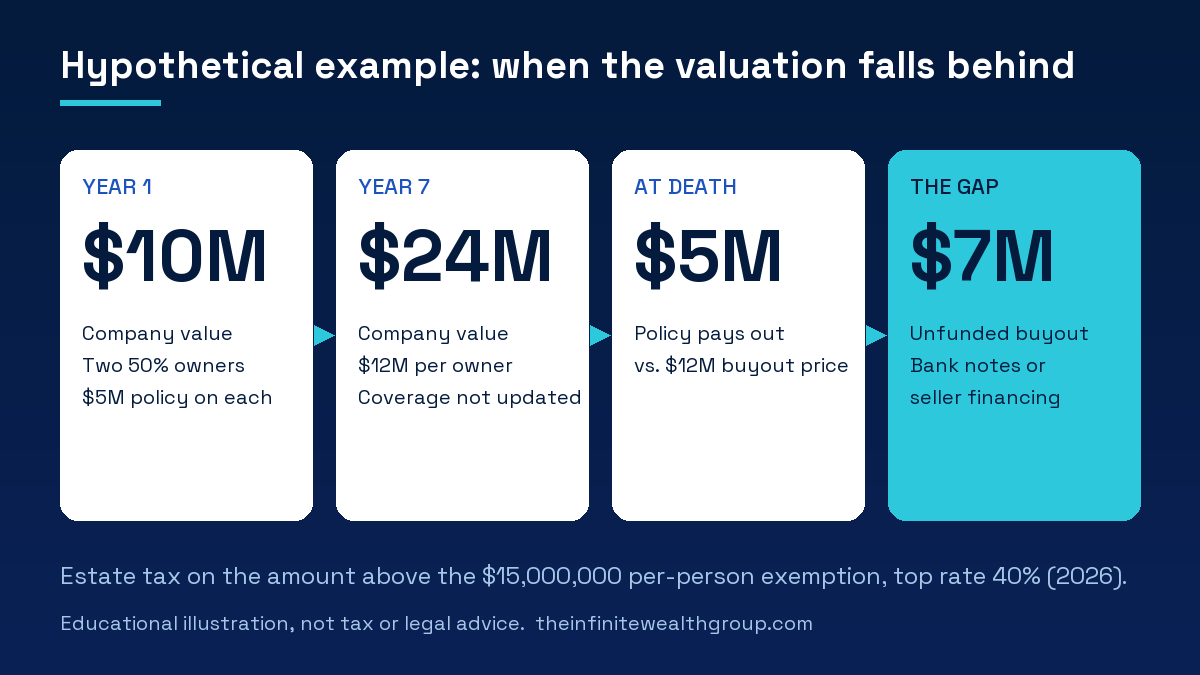
Consider a hypothetical example:
- Year 1: Two Chattanooga co-owners each hold 50% of a logistics and warehousing company valued at $10,000,000. They sign a cross-purchase buy-sell agreement and each buys a $5,000,000 life insurance policy on the other.
- Year 7: The company has grown to $24,000,000 in fair market value ($12,000,000 per partner), but the owners never updated their coverage or their fixed valuation.
- The crisis: If one partner dies in Year 7, the existing policy pays $5,000,000, leaving a $7,000,000 unfunded buyout gap. Meanwhile, the deceased partner’s 50% share may be valued at $12,000,000 for federal estate tax purposes. If the deceased partner’s total estate exceeds the $15,000,000 per-person exemption, the estate owes federal estate tax at rates up to 40% on the amount above the exemption, on a short federal deadline, while the surviving partner scrambles to finance the $7,000,000 shortfall through bank notes or seller financing.
To prevent this gap, our business owner life insurance strategies review includes a regular policy-to-valuation check alongside your CPA, pairing your growth trajectory with guaranteed insurability options or additional coverage layers before health changes make new coverage harder to get. For detailed mechanics on how buyout triggers and valuation clauses interact, read our guide on using life insurance to fund business succession and coordinate your personal trust structure through estate planning with life insurance and ILITs.
5-Point Buy-Sell Policy Audit Checklist for Tennessee Owners
Before your next annual shareholder or LLC meeting, pull the actual life insurance policy contracts, not just the legal agreement, and verify these five items with your attorney, CPA, and life insurance agent:
- Check the “Owner” and “Beneficiary” lines on every policy: If the operating company is listed as owner or beneficiary, ask your tax counsel whether Connelly exposes your estate to a higher company valuation.
- Compare total death benefit to current enterprise value: Does each policy match that partner’s current ownership share, or is there an unfunded gap that would force a bank loan at death?
- Verify IRC § 101(j) employer-owned life insurance compliance: For any policy where an entity is the owner, confirm that written notice and consent were signed before the policy was issued and that IRS Form 8925 is filed with the business’s tax return each year.
- Check term expiration and conversion deadlines: If your buy-sell relies on term life insurance, verify when the level-premium period ends and when the right to convert to permanent coverage without new medical underwriting expires.
- Coordinate disability and retirement triggers: Confirm whether you have separate disability buyout coverage or cash value accumulation to handle a non-death exit.
Frequently Asked Questions
Are life insurance premiums for a buy-sell agreement tax-deductible in Tennessee?
Generally, no. Under federal tax law (IRC § 264), premiums on life insurance where the payer is directly or indirectly a beneficiary, which describes most buy-sell policies, are not tax-deductible, whether the company pays them in an entity redemption or the partners pay them in a cross-purchase. The death benefit itself is generally income-tax-free under IRC § 101(a), subject to exceptions such as the transfer-for-value rule and the 101(j) notice and consent rules. Always confirm tax reporting with your CPA.
Does Tennessee charge a state inheritance or estate tax on a business buyout?
No. Tennessee has no inheritance tax for deaths after December 31, 2015, and no state estate tax. However, Tennessee business owners remain subject to the federal estate tax, which applies a 40% top rate to taxable estates above the 2026 federal exemption of $15,000,000 per person ($30,000,000 for a married couple with portability).
What happens to buy-sell life insurance policies if we sell our business or a partner retires?
In a cross-purchase agreement, a retiring partner can often buy the policy on their own life as part of the buyout, because a transfer to the insured is an exception to the IRC § 101(a)(2) transfer-for-value rule. Once owned personally, the policy can be repurposed for family estate planning. If it is later gifted to an Irrevocable Life Insurance Trust (ILIT), the proceeds are pulled back into the estate if the insured dies within three years of the transfer (IRC § 2035).
Why is a missing or unsigned IRC § 101(j) notice dangerous for company-owned policies?
When a business owns a life insurance policy on an employee or owner, IRC § 101(j) requires written notice to the insured and the insured’s written consent before the policy is issued, plus annual reporting on IRS Form 8925. Without valid notice and consent, and unless an exception applies, the death benefit above the premiums and other amounts paid can become taxable income.
How can we check if our current Tennessee buy-sell policies are structured properly?
You can book a confidential policy review with The Infinite Wealth Group in Chattanooga at (855) 526-2979. We review the ownership, beneficiary designations, policy guarantees, and coverage amounts on your existing policies and coordinate directly with your corporate attorney and CPA so your legal agreement and your insurance contracts match.
Related Articles
Have Questions?
Book a free fifteen-minute discovery call with Brandt. No pitch, just your numbers and a straight answer.
Explore Our Strategies

Brandt Hudson
Founder of The Infinite Wealth Group, a Chattanooga, TN life insurance agency. Licensed insurance professional; designs infinite banking, LIRP, defined benefit, estate and business exit strategies across roughly fifty carriers.