
Premium Financing Life Insurance Risks & Exit Plans
Life insurance premium financing lets high-net-worth families fund large estate-tax policies inside an Irrevocable Life Insurance Trust (ILIT) using a third-party bank loan rather than liquidating real estate or operating businesses. However, premium financing is a commercial credit transaction with three serious risks: floating interest rates, 100% collateral requirements, and the need for a disciplined 14-to-18-year exit plan.
Over the past decade, many wealthy families were shown glossy sales spreadsheets that assumed borrowing rates would stay near historic lows forever while policy returns climbed in a straight line. When benchmark interest rates rose and policy crediting rates reset downward, borrowers who were never shown a stress test received unexpected six- and seven-figure collateral calls from their lenders.
At The Infinite Wealth Group, our Chattanooga independent life insurance agency designs and audits life insurance premium financing strategies for families with a minimum net worth of $10 million and typically $20 million to $100 million or more in illiquid business or real estate assets. Before we ever place a financed policy, we walk you, your CPA, and your estate attorney through everything that can go wrong and how to engineer the policy and loan to survive worst-case credit cycles.
Educational note: The Infinite Wealth Group is an independent life insurance agency. This article provides general insurance education, not tax, legal, or investment advice. Always review loan documents, trust terms, and tax rules with your estate attorney and CPA.
What Are the Three Core Risks of Life Insurance Premium Financing?
Every premium-financed life insurance arrangement carries three structural risks: interest rate risk on the floating bank loan, collateral call risk whenever policy cash surrender value trails the cumulative loan balance, and exit strategy risk when the loan must eventually be repaid. A sound plan stress-tests all three before day one.
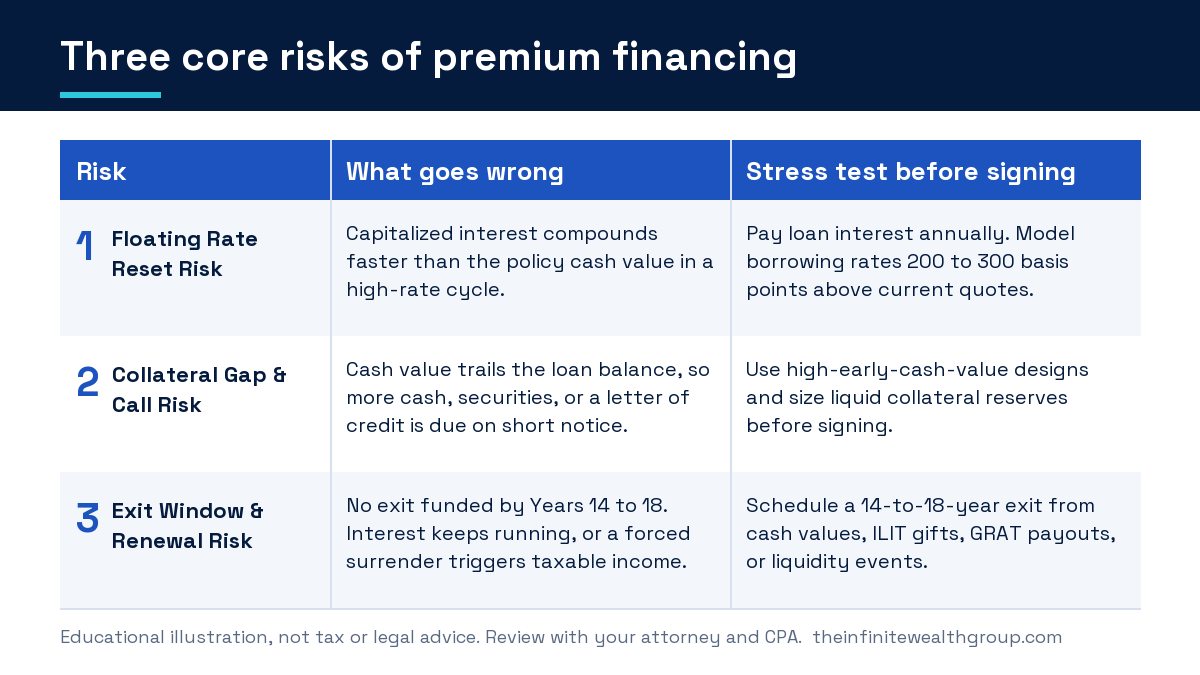
When an ILIT borrows funds from a specialty insurance lender to pay life insurance premiums, the bank is not taking mortality risk or policy performance risk. The bank is making a fully secured commercial loan. Here is how the three core risks interact over the life of the loan:
| Risk Category | How the Mechanism Works | What Goes Wrong in a Bad Design | Pre-Issue Stress Test Standard |
|---|---|---|---|
| 1. Floating Interest Rate Risk | Loans are typically priced at 1-month or 12-month SOFR (or Prime) plus a lender spread of 150 to 250 basis points, resetting annually or monthly. | If the borrower capitalizes interest (adds unpaid interest onto the loan principal) during a high-rate cycle, the loan compounds faster than the policy’s cash value. | Pay loan interest out of pocket annually rather than compounding it, and model borrowing rates 200 to 300 basis points above current quotes. |
| 2. Collateral Call Risk | The lender requires 100% collateral security for every dollar of principal and accrued interest at all times. | Policy cash value in early years (or after a low crediting year) is less than the loan balance, forcing the borrower to post additional cash, marketable securities, or a letter of credit on short notice. | Use high-early-cash-value policy designs with contractual cash value schedules and size liquid collateral reserves before signing. |
| 3. Loan Renewal & Exit Strategy Risk | Premium finance credit facilities are written for fixed terms (usually 3, 5, or 7 years), not for life. The loan must be renewed at maturity and eventually retired. | If no exit is funded by Years 14 to 18, loan interest keeps running into the insured’s 70s and 80s, or a forced surrender triggers taxable phantom income under IRC § 72. | Build a scheduled 14-to-18-year exit using policy cash values, annual ILIT gifts, GRAT payouts, or planned liquidity events. |
How Do Floating SOFR Rates and Loan Renewals Affect Your Policy?
Premium finance loans are commercial credit facilities tied to floating benchmarks like SOFR or Prime plus a credit spread, and they must be renewed every three to seven years. If borrowing costs rise or if interest is rolled into the loan balance, the debt can snowball rapidly.
Two mechanics catch borrowers off guard when they review a bank commitment letter for the first time:
1. Capitalized Interest vs. Paying Interest Current
Some proposals pitch “zero out-of-pocket cost” by borrowing both the annual insurance premium and the annual loan interest. That means the loan balance grows through compound interest every single year. If a trust borrows $500,000 per year for seven years ($3.5 million in total premiums) and rolls 6.5% interest onto the loan instead of paying interest annually, the debt rapidly climbs past $4.6 million.
In our practice, we strongly prefer that clients pay the annual loan interest current (often funded through annual exclusion gifts of $19,000 per beneficiary in 2026 under IRC § 2503(b) or lifetime exemption gifts into the ILIT, properly documented with Crummey notice requirements for an ILIT). Paying the interest each year keeps the loan principal flat once the premium funding period ends.
2. Three-to-Seven-Year Loan Renewal Windows
A life insurance policy is a 30-to-40-year contract, but a premium finance note is a 3-to-7-year credit facility. At each maturity date, the lender re-underwrites the borrower’s net worth, liquidity, and collateral coverage. If credit markets tighten or the lender exits the sector, the trustee must either renew at the prevailing spread or refinance the loan with a new lender. You can compare how bank loan rates stack up against internal policy loan mechanics on our Policy Loan vs. Bank Loan Calculator.
Why Do Collateral Calls Happen and How Does the Flex Rule Prevent Surprise Gaps?
A collateral call happens whenever the policy’s cash surrender value plus already-pledged outside collateral falls below 100% of the outstanding loan balance. Remember one ironclad banking rule: excess death benefit above the loan balance counts for $0 of collateral while the insured is alive.
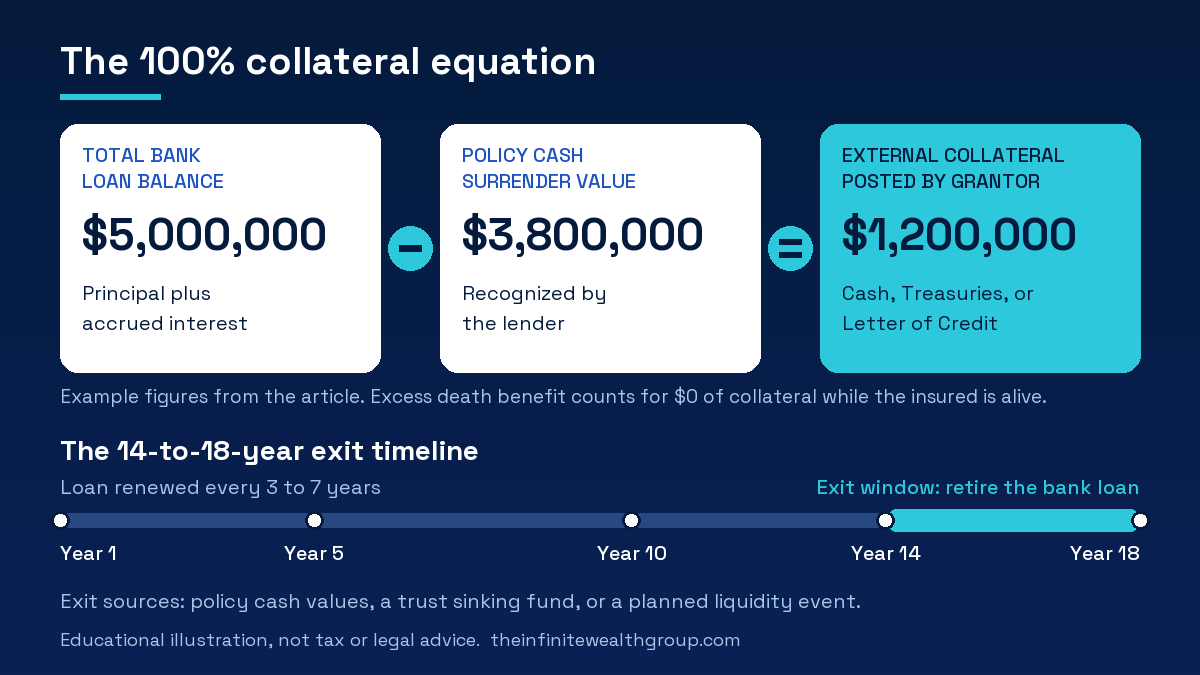
When a lender extends a $5,000,000 premium finance loan, the lender assigns an advance rate (typically 95% to 100%) to the policy’s cash surrender value, the exact dollar amount the insurance company would wire if the policy were surrendered that afternoon. If the policy has $3,800,000 of recognized cash value, the borrower must post $1,200,000 of external collateral (such as cash equivalents, a pledged brokerage account with margin haircuts, or a bank letter of credit).
Why do surprise collateral calls happen? In public court complaints and regulatory filings over the past several years, borrowers have alleged that they were sold financed Indexed Universal Life (IUL) policies using aggressive illustrations. In one widely cited complaint, where the allegations remain contested court claims, a borrower alleged that after an early interest bonus rider expired, the policy’s crediting rate dropped from 13.5% down to roughly 7% while floating loan rates rose, resulting in a lender demand for $500,000 in additional collateral by the following Tuesday.
Brandt’s “Flex Rule”: Why Policy Chassis Matters Inside a Bank Loan
To be fair and accurate, Indexed Universal Life (IUL) is a legitimate insurance product that can work in premium financing when conservatively illustrated, and some IUL cases hold up over time. However, our agency chooses to place only high-cash-value participating whole life insurance inside premium finance loans.
We call the reason The Flex Rule:
- A bank loan is rigid. The lender demands 100% collateral verification every twelve months regardless of what the stock market or index caps did that year.
- When the loan is rigid, the policy’s collateral floor cannot be flexible. In an IUL policy, a 0% floor year combined with internal cost-of-insurance deductions can cause the policy’s cash value to stall or decline right as the bank loan grows, widening the collateral gap overnight.
- Whole life provides a contractual cash value schedule. In a participating whole life contract, the policy has a guaranteed level premium, a guaranteed death benefit, and a guaranteed cash surrender value table printed in the contract from day one. All guarantees are backed by the issuing insurer’s claims-paying ability and assume required premiums are paid. While mutual carrier dividends are not guaranteed, they have historically added a second layer of non-guaranteed cash value growth on top of the guaranteed floor, and we stress-test every design by reducing the current dividend scale by 50 to 100 basis points.
Because the guaranteed cash value schedule in whole life cannot go backward as long as required premiums are paid, you, your CPA, and your banker can see the worst-case collateral gap years in advance instead of getting a surprise Tuesday phone call.
How Do You Build a Realistic 14-to-18-Year Exit Strategy?
A premium finance loan is a bridge, not a permanent home. Every financed policy needs a written exit plan to pay off the third-party bank loan, typically between Policy Years 14 and 18, without forcing a policy lapse that triggers taxable income.
Why is a planned exit so critical? If a borrower simply walks away from a heavily loaned policy or lets it lapse during their lifetime, IRC § 72 treats the extinguished loan balance above the policy’s cost basis (cumulative premiums paid) as a taxable distribution. Worse, the trust receives zero cash from a lapsed policy with which to pay that income tax bill.
When we coordinate estate planning with life insurance and ILITs for families in Tennessee (where there is no state inheritance tax, leaving the 40% federal estate tax above the $15,000,000 per-person / $30,000,000 married 2026 exemption as the primary estate tax liability), we design three primary exit ramps:
- Policy Cash Value Rollout (Years 14 to 18): Once the whole life policy’s accumulated cash value has grown large enough that a partial withdrawal to basis or an internal policy loan can retire the outside bank loan while leaving a healthy permanent death benefit in force, the trustee pays off the bank and closes the external collateral account.
- External Trust Sinking Fund (GRATs, CLATs, or Annual Gifts): For life insurance strategies for business owners who hold rapidly appreciating company stock or commercial real estate, the estate attorney often pairs the ILIT with a Grantor Retained Annuity Trust (GRAT), installment sale to an Intentionally Defective Grantor Trust (IDGT), or annual gift program. As assets appreciate inside the trust outside the taxable estate, those trust funds pay off the bank loan in cash, leaving 100% of the policy’s cash value and death benefit intact.
- Planned Business Exit or Liquidity Event: When owners integrate premium financing with their business protection and succession planning, proceeds from a partial recapitalization or sale of a division are earmarked to retire the insurance loan early.
5-Point Stress-Test Checklist Before Signing Any Premium Finance Commitment
Whether you are evaluating a new proposal or auditing an existing financed policy, demand to see these five stress tests in writing before you sign:
- Show the illustration at current dividend scale minus 100 basis points (or IUL at 150 basis points below illustrated cap): Does the exit timeline still work within 18 years if non-guaranteed policy credits underperform?
- Show borrowing rates 200 basis points higher than today’s SOFR + spread quote: How much extra annual interest and outside collateral would you need in Years 3, 5, and 10?
- Show the Year-by-Year External Collateral Schedule under Guaranteed Cash Values Only: What is the absolute maximum outside collateral you could ever be asked to pledge if zero non-guaranteed dividends were paid?
- Confirm zero incidents of ownership by the insured under IRC § 2042: Has independent estate counsel confirmed that any personal guarantee or collateral pledge by the insured is structured so it does not pull the death benefit back into the taxable estate?
- Identify the exact dollar source for the Year 14-to-18 loan payoff: Is the bank loan being retired via policy cash values, a trust sinking fund, or a scheduled liquidity event, and how much net death benefit remains at age 85 and age 90 after payoff?
Frequently Asked Questions
Who qualifies for life insurance premium financing?
Most institutional premium finance lenders require the borrower or guarantor to verify a minimum net worth of $10,000,000, along with sufficient liquid assets to cover projected external collateral and annual interest payments. In practice, premium financing makes the most sense for families with $20,000,000 to $100,000,000+ in net worth who face a 40% federal estate tax above the 2026 exemption of $15,000,000 per person ($30,000,000 for a married couple) and want to keep their capital working inside an operating business or real estate portfolio.
Does the life insurance death benefit count as collateral for a premium finance loan during my lifetime?
No. While the insured person is alive, the lender only counts the policy’s current cash surrender value (typically discounted by a 95% to 100% advance rate) toward the collateral requirement. Any gap between the total loan balance and the recognized cash surrender value must be covered 100% by external collateral such as cash, Treasury bills, marketable securities, or a bank letter of credit.
Can premium-financed life insurance guarantee that policy growth will beat the loan interest rate?
No. Anyone who promises guaranteed arbitrage or claims a policy is guaranteed to out-earn a floating bank loan is misrepresenting how both banking and insurance work. Loan interest rates float with market benchmarks like SOFR, while policy dividends on whole life (or index credits on IUL) are not guaranteed. Only the base contractual cash value schedule and base death benefit on a whole life policy are guaranteed, backed by the issuing insurer’s claims-paying ability and assuming required premiums are paid.
What happens if we already have an underperforming premium-financed IUL policy?
If you hold an existing financed policy where rising loan rates or lower crediting rates have widened your collateral gap, do not let the policy lapse without a tax audit. I can run an in-force rescue analysis alongside your CPA and estate attorney to evaluate whether refinancing the credit facility, restructuring the collateral, paying down principal, or executing a tax-free IRC § 1035 exchange into a contractually guaranteed whole life chassis is viable.
How can we request an independent stress test of a premium finance proposal?
Call The Infinite Wealth Group in Chattanooga at (855) 526-2979. We will run a side-by-side stress test of any proposed or existing premium-financed policy across rising SOFR scenarios, reduced dividend scales, and Year 14-to-18 exit timelines so you, your CPA, and your estate attorney can see the real numbers before committing.
Related Articles
Have Questions?
Book a free fifteen-minute discovery call with Brandt. No pitch, just your numbers and a straight answer.
Explore Our Strategies

Brandt Hudson
Founder of The Infinite Wealth Group, a Chattanooga, TN life insurance agency. Licensed insurance professional; designs infinite banking, LIRP, defined benefit, estate and business exit strategies across roughly fifty carriers.